
Many a remembrance was tweeted to honour the memory of Christopher Rios last week. The rapper known as “Big Pun” died February 7th, 2000, from a heart attack and respiratory failure. At the time of his death, Rios was 698lbs. The strain his morbid obesity placed on his cardiological and respiratory systems had been evident in his music: with a delivery like an automatic weapon, Rios had become ensconced in the pantheon of modern lyricists, but his laboured breathing was as signature as his syllabic fury. That his weight threatened his life was not lost on the Bronx native. He had enrolled in a weight-loss program, but left prior to its completion. The premature loss of a father, husband and friend is always sorrowful. In the case of Rios there was an element of tragedy as well: he was brought to ruin by weakness. But this sad tragedy was anything but unforeseen. Human beings aren’t supposed to weigh 700lbs.
The writing was on the wall for Big Pun; the writing is on the wall for Shane Mosley.
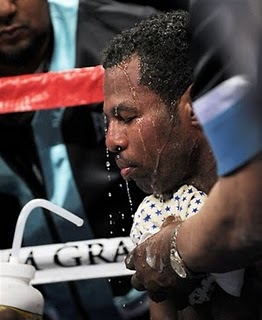
This isn’t to say that Mosley, who is slated to battle crimson avenger Saul Alvarez on May 5th, is going to terminate with his latest fight. It would be tastelessly dramatic to pursue this line of reasoning with a pugilist as preserved as Mosley. Mosley may indeed suffer irrevocable damage as he pushes his career into its second decade, and he is due for a stoppage defeat, but Alvarez is unlikely to do much more than begrime Mosley’s professional ledger. That a fighter of Alvarez’ calibre is a significant betting favourite over the pride of Pamona (Alvarez -900/ Mosley +500) is significant, however. Just as Big Pun’s weight was a harbinger of his premature demise, there is substantial evidence that Mosley will enter the ring in May an empty vessel.
Mosley, once the sole practitioner of “power boxing,” no longer throws in combination. He is content to paw with his left hand, rip the occasional straight-right, and fall into the arms of the opposition. His left hook is probably still formidable, though many a calendar has been binned since he shook someone’s foundation with it. The last time he managed to catch lightning in a bottle was May of 2010, when he momentarily stunned Floyd Mayweather. Those powerful shots landed early in the second round of the fight. Mosley lost the remainder of the round. The once dynamic apex predator was handcuffed by Mayweather, and beaten so soundly over the remaining rounds that trainer Naazim Richardson threatened to stop the fight.
A dreadful draw with Sergio Mora followed, earning Mosley a shot at Manny Pacquiao. The Pacquiao fight was a glorified sparring session replete with supererogatory glove touching (Spar intr.v To make boxing or fighting motions without hitting one’s opponent). What is particularly noteworthy is that Shane shied away from combat against Pacquiao, and was dropped for only the second time in his career. Shane hadn’t suffered a knockdown since 2002, when Vernon Forrest’s uppercut almost decapitated the already concussed fighter. Moreover, against Pacquiao, Mosley contemplated giving up. The comfort in violence that typified Mosley’s career was gone. It’s unlikely that the dying embers of his combative fire can warm Mosley to the task at hand.
If there is any moral ground for opposing this fight it’s that Mosley’ tongue is becoming corpulent. He is fairly well-preserved for a first-ballot professional of 55 fights, but an erosion of motor skills is evident. As the causes and consequences of brain injuries occupy more of the sporting spotlight, concern for Mosley’s future is understandable. Perhaps there is greater concern for the future of Alvarez.
Regardless of the warning signs, if Mosley is licensed, if he is willing to endure another training camp, if he is willing to lose to someone he would’ve annihilated in his prime, he should be allowed to fight. His durability and proclivity for destroying aggressive fighters are arguments, however threadbare, that he might threaten Alvarez. Of course, that he has been chosen as an opponent for the pride of Golden Boy Promotions is a sound argument that this threat is chimerical—the most legible writing on the wall.
 In Between Rounds