Clockwise: A Preview of Morales – Garcia

As I was about to toss the chicken bones on the floor and conjure up a prediction, my fire alarm went off. There wasn’t any smoke mind you, save for the incense burning to mask the smell in the cauldron. The sharp beep was merely tolling the death of the alarm’s battery. I hadn’t changed it since I moved in, so I suppose that this lesser warning was to be expected. It was only a matter of time. As always, good luck in your predictions leagues.


Strong Opinions: Appraising the Antics of Adrien Broner

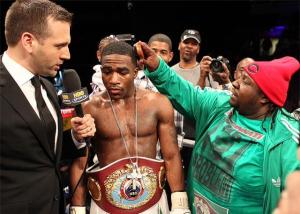
His chosen sobriquet is especially fitting: Adrien “The Problem” Broner is just that. He’s a formidable fighter, with a particularly problematic dynamic of offensive and defensive prowess. These fistic virtues are well established; there’s little trouble assaying the undeniable abilities of Adrien Broner. He should prove to be a rather baffling riddle for opponents for some time. Appraising his antics however, and their effect on his career, are much more difficult tasks.

For some, his rapping and hair brushing are merely manifestations of the confidence required to take part in compromising violence. The Broner apologist might suggest that the gaudery evidences Broner’s security in his own abilities, his willingness to increase the stakes by adding to audience expectations. A man who’s as brash as Broner must do more than simply win: he has upped the ante, adding an aesthetic demand to his ring exploits that must also be satisfied to meet the expectations of the performance. Those who appreciate the theatrics can defend Broner on the grounds that he’s challenging himself to be more than a fighter, but an entertainer as well. And in being an entertainer, Broner is garnering an audience.

For others, Broner’s antics, the thespian quality of his time in front of the camera, are merely a product of a benign childishness. Broner—at only 22 years of age, and yet years deep into his profession—has certainly committed much seriousness to the exacting demands of his particular vocation. Given such a sacrifice, those who take this position argue that the playful young man should be permitted his potentially off-putting antics as merely a byproduct of his age. He isn’t being forcibly escorted through the doors of nightclubs, experimenting with psychedelia, or participating in other activities associated with the edifying hooliganism of many a man his age. At 22, he has spent considerable time under the scrutiny of others, and so his innocuous routine should be forgiven. It’s an instance of child’s play in a man’s art, and it isn’t without precedent.

There’s a third faction which loathes the arrogance and the pomp, that cannot palate the superfluous choreography accompanying the bruising dance. Those who find the ceremonial grooming and rehearsed interviews so distasteful identify a degree of disrespect in Broner’s antics. There’s very little playful about a sport where men break their hands striking their opponents, and some believe the entire edifice is trivialized by Broner’s clownish histrionics. Even a less severe judgement of Broner’s schtick can sketch a rather obnoxious, juvenile portrait. For many, the absence of decorum in Broner’s celebration is an indictment of his class. Perhaps these cruel strokes are fitting, and Broner is guilty of an arrogant idiocy that has no place in what McIlvanney so appositely titled ‘The Hardest Game’.

Applying a Venn-diagram to the above portraits would probably reveal a more temperate characterization: the overlapping sections of the three circles permitting just enough of each perspective to prevent too rigid a characterization. Yes, he has conducted himself as a professional in regards to his first priorities, evidenced by a surgical and definitive stoppage of Eloy Perez last week. But the question of what to make of Broner can’t be satisfied by his record. His performance, which he clearly puts much preparation into, entails more than what he accomplishes during the fight. Adrien Broner wants viewers to evaluate the entire package. He must be pleased to know that many are considering him as just such a whole, though there’s striking disagreement over the sum of those parts.

This process of appraising Broner has spawned a second question.

There’s a line of reasoning proposing that Broner’s theatrics augment his fistic endeavours. It seems intuitive to assume a connection between a noteworthy performance—for whatever reason—and increased viewership. A week removed from his knockout of Perez and people are still discussing Broner’s histrionics, proof enough that his extracurricular activity is memorable. The more interesting question is: will Broner’s antics make him a star?

Broner, particularly in Cincinnati and neighbouring cities, will probably increase attendance at the cards he performs on. This impact can be expected to increase as Broner continues to win under the lights of a major network (conditions which seem likely as Broner is probably the best fighter in his division, and is an HBO staple). Promoted properly, Broner might even develop into a solid regional attraction, somewhere along the lines of Tomasz Adamek or Fernando Guerrero.

But neither Adamek nor Guerrero boasts the appeal of a Mayweather or Pacquiao—neither fighter is a superstar. Of course, neither Adamek nor Guerrero augment their performances with the self-promoting histrionics of Broner. The added ostentation is an important factor, as talent alone has proven insufficient for stardom. Will his polarizing gaudery then, allow Broner to achieve the status of the sport’s most popular practitioners? Or will his antics’ greatest achievement be the production of a schism among preexisting fans, with those eyes that were going to watch regardless simply observing with a reduced impartiality?

The most interesting problems tend to produce more questions than answers. They boast a complexity that requires layers of deconstruction, revealing multiple avenues of further inquiry. It’s often best to handle such puzzles with a cautious rumination. Perhaps Adrien “The Problem” Broner, both in his polarizing affectations, and his star potential, should be catechized with similar diligence, though it’s unlikely that most minds aren’t already firmly made up.

Critical Mass: Early Questions About Gamboa – Rios

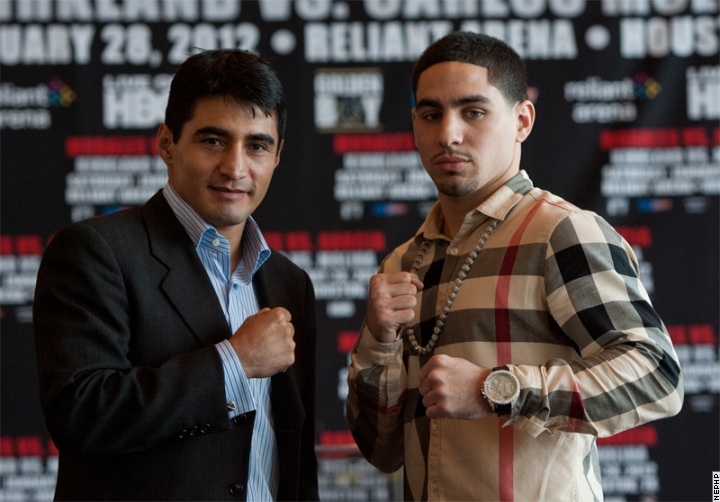
On April 14th, featherweight Yuriorkis Gamboa is scheduled to face lightweight rancor Brandon Rios. At first glance this is a delectable dialectic of speed, power, size, and strength that promises drama and excitement. While the foregone conclusion becomes increasingly normative in big fights, Gamboa – Rios doesn’t lend itself particularly well to prognostication. The difficulty in predicting an outcome hinges primarily on how both fighters will respond to being lightweights. The influence of the scale betrays the fact that at 135lbs neither fighter may be operating at his optimum weight.

Gamboa will be moving up two divisions to challenge for the title Rios lost on the scales. If he chooses to bulk up to increase his strength and durability, this added mass could prove problematic. The Cuban is a dense and muscular featherweight; the question of whether he can add enough functional size to be an effective lightweight is a legitimate one. Even if he adds the weight properly, his superlative speed stands to be encumbered by the added bulk. His hands will remain blindingly fast regardless of the increase in size, he could hold ten pound dumbbells and still throw faster than Rios. But for a fighter whose defence is predicated on movement both the decrease in speed and the tax of maneuvering a heavier body about the canvas could prove his undoing. This threat is exacerbated both by Gamboa’s tendency to become increasingly skittish later in fights—when he holsters his most spectacular weapons—and Rios’ traditionally strong finish. To be stationary against Rios is suicide. If Gamboa’s intrepid first venture north is accompanied by an inability to evade a hard charging Rios, what transpired in the early rounds will probably be rendered moot by Rios’ inexorable artillery.

Of course, Gamboa may transition seamlessly into the lightweight division. Rather than focus on crafting a lightweight’s body, he may simply allow his frame to expand naturally. Instead of whittling down to 135lbs, he could approach the fight with the intention of barely surpassing the lightweight limit by the time he starts his ring walk. The threat here is that he will then be facing a fighter who is two weight divisions larger. Gamboa will retain all of his dynamism, but concede every possible size advantage to his opponent—an opponent whose style is predicated on capitalizing on those very same advantages.

Rios faces his own challenges with the lightweight division. He has profited from essentially fighting as a welterweight: his durability and power stem from his massive size and the fact that he exchanges blows with fighters he dwarfs. Rios’ body however, seems increasingly less willing to cooperate. In his last fight, when he was stripped of his title for failing to make weight, Rios looked like an achromatic adumbration of himself. He has obstinately remained at lightweight to exploit his natural advantages, but the demands of a maturing body are even more refractory. Perhaps Rios’ struggles with the scale speak more to his preparation and commitment than they do his physiology. Ultimately, determining why Rios finds making weight so challenging is a secondary matter to this enterprise. What is relevant is the fact that, regardless of the explanation, making 135lbs could have a detrimental impact on Rios’ performance.

It may be that Rios’ last fight—where he was stripped of his title for failing to make weight—was an aberration, and that the circumstances that produced his first fight of that weekend have been rectified. However, it is just as possible that those struggles were the death knell of his term at lightweight. On that weekend in April, the battle with the scale may be the only one he can fight.

The questions posed by the lightweight limit present a number of outcomes. Rios, if he makes weight without exhausting himself, seems durable enough to absorb the speed and power of a recent featherweight. However, if Rios again endures attrition on the scale the argument for a Gamboa victory becomes increasingly more plausible. If both men struggle at lightweight an even fight may break out, but the counterbalance will be negative: neither fighter will be at his best, robbing the contest of some of its appeal. Regardless of what transpires between the ropes, the scale will probably factor heavily in the outcome. (Especially if Rios fails to make weight and Gamboa walks—which is exactly what he should do under those circumstances.)

With the scale come excuses.

If Rios wins many will attribute his victory to an insurmountable size discrepancy. And how much credit does he deserve for beating a featherweight moving up two divisions to fight him? If Gamboa wins, Rios apologists will say he outgrew the division and Gamboa merely finished what the scale started. None of these narratives may prove true, but the fact that they can so easily be appropriated by the overarching storyline of the fight speaks to the complexity of the contest.

Given this myriad of questions, Gamboa – Rios is undeniably intriguing. That Gamboa has the audacity to challenge a masquerading welterweight without first acclimatizing to the lightweight division should be applauded. This is not Jones – Ruiz: Rios is arguably the best lightweight in the world if Juan Manuel Marquez campaigns at junior-welterweight. He is certainly the biggest bruiser on the block. Perhaps Gamboa sensed that his development as a draw has stagnated in its infancy and he thought it best to seize the boxing world’s imagination. It could be that he thinks Rios plays to his strengths stylistically. It’s a perilous move regardless, and his bravery should be celebrated. This is prize fighting—and Gamboa is big game hunting.