
Saul Alvarez remains the undisputed super middleweight champion of the world. Alvarez cruised to a unanimous decision victory over Jaime Munguia at the T-Mobile Arena in Las Vegas, on Saturday.
While impressive for its craft, for what Alvarez is still capable of, the fight was mostly uneventful, save for a fourth-round knockdown scored by Alvarez on a perfect right uppercut. That was enough for what was primarily an event, one that benefitted (as every Alvarez fight does) from rabid Mexican support feverish from the calendar and the presence of a Mexican opponent. The tortured logic required to find drama in a fight some saw as protracted by Alvarez’s mercy is unnecessary.
***
The matchmaking was a correction on Alvarez’s last title defense, that punchline with junior middleweight Jermell Charlo. When punching down in competition, it is best to find someone who ignores the obvious—even while it is drummed into his skull. Munguia fought to win and proved sturdy and determined, turning in the kind of effort that would make him a hero if his name was Jamie Montgomery, his passport emblazoned with a lion and unicorn. Munguia knows now what it takes to beat an elite fighter, even an aging one, and can rest easy knowing the division recently lost the only two other fighters who might warrant that distinction.
Alvarez, meanwhile, went twelve rounds again and is without a stoppage since he folded Caleb Plant in 2021. He remains an elite counterpuncher, and if Munguia’s strategy is any indication, that reputation weighs on his opponents before he’s thrown a punch. There were times when Munguia, as if catching himself overcommitting to his offense, to the only prayer he had for victory, would back out of range and bounce on his toes—harmless, yes, but unharmed. Like Terence Crawford, Alvarez remains a fighter against whom you must question your every success and whether the penalty of securing it won’t prove ruinous.
But maybe that isn’t good enough.
***
They booed him: a shift forceful, unanimous as it was immediate, from cheers into a universal language—the disgusted digraph. The people did that—his people. The ones who cross state lines and borders, even oceans to celebrate him—needed not a second to perceive something unbecoming in his response to the mention of potential rival David Benavidez. And so they responded not as devotees of a fighter but of an ideal; this hive-mind of passion and expectation who have always taken solace in their fighter doing what others would not, being what others could not, had heard enough. Alvarez is not the embodiment of that fighting ideal anymore, not enough of it, at least. That might be acceptable, forgivable if he didn’t admit it, didn’t say what he has been showing for some time.
So Alvarez pivoted to safety, found an opening, and countered with his best, reminding all of his achievements, the fights that put three divisions on hold in anticipation of two fights a year, the fights he made and won, and dedicated to the very people who just scolded him. It was a strategy that worked, for now.
Alvarez told the crowd he does what he pleases, that his past has earned him this curated future. And he is right. His legacy will soon be subject to the scalpel; whatever mischief hands clumsy or expert might do in dissection, Alvarez’s standing is secure so long as he is compared not to an ideal but to his contemporaries. Besides, “Canelo” has been doing what he wanted for years, and the Benavidez dance is less a cause than a symptom of his intentions.
Should that fight fail to transpire, few will care for very long. And no single fight can undue a career or reputation like Alvarez’s. But what do you think about a fighter who can do what he wants, wanting Gennadiy Golovkin a third time, John Ryder, Jermell Charlo, Jaime Munguia, and possibly Edgar Berlanga?
***
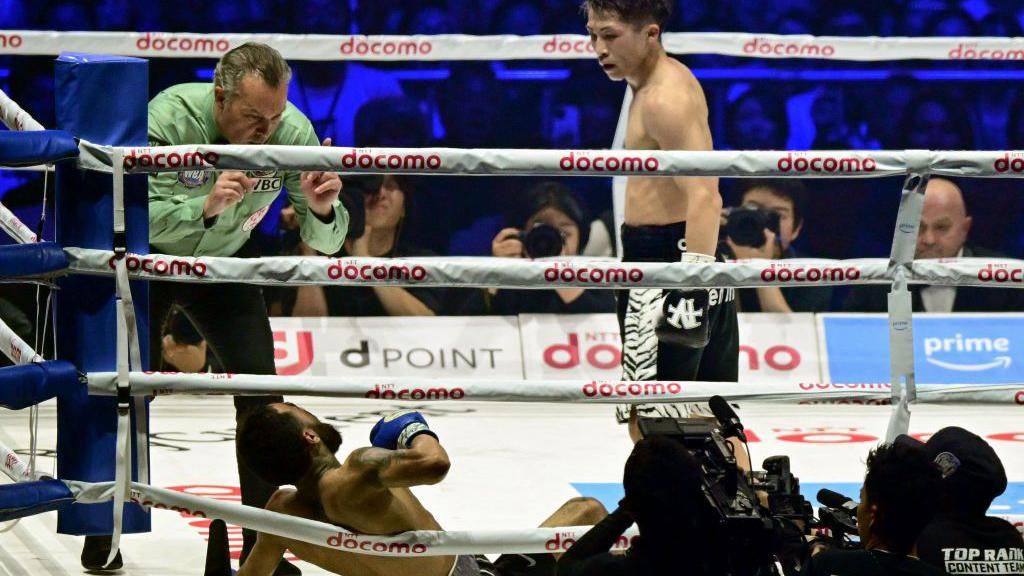
Silence spread through the crowd at the Tokyo Dome in Tokyo, Japan, Monday—55,000 voices choked. Luis Nery said he would exploit flaws in Naoya Inoue’s technique, the same Inoue who has appeared impossibly perfect in conquering one division after another before settling in, for now, as the undisputed super bantamweight champion. Credit to Nery: he made good on what is too often empty prefight bluster, becoming the first man to drop Inoue, flooring him with a left hook in the first round.
Like Alvarez’s poor answer 36 hours earlier, that punch created a point of divergence. Do you emphasize the first-round knockdown in your assessment of Inoue, a technical flaw identified in advance and exploited almost immediately? Or what followed it, a brutal six-round destruction punctuated by a short cross that kicked like a defibrillator.
Those who prioritize the knockdown might suggest that Inoue has been able to compensate for any flaws in his game with athleticism and deliquescing power (a power he needn’t even land to wield effectively), and rightly note that there will be less room for error with added pounds. They might also, less tenably, suggest that Inoue is overrated, or worse, a hype job. That proof will come when Inoue loses, regardless of what he accomplishes prior.
What does looking at the fight as a whole reveal? A fighter who could soon be knocking featherweights cold.
***
The Japan Boxing Commission recently reinstated Nery after issuing him a lifetime ban for PED and weight infractions in 2018. Why? Because Nery was good theater, a proper villain for Inoue to vanquish. The knockdown proved him perfectly cast. Inoue isn’t perfect, and Nery was an instructive reminder of that. As with Nonito Donaire and Marlon Tapales, Inoue seemed appreciative of Nery: the fighters who remind him of his Icarian risk are the ones who motivate him, who confirm his greatness. Inoue claimed to have forgotten the instructions his father and trainer, Shingo Inoue, gave him before the second round, and it is easy to imagine Inoue, his mind fixated on revenge, failing to register that counsel. Thankfully, “The Monster” does not carry opponents to prove his dominance.
***
We should appreciate the likes of Nery, too. The fighters who strike our idols and reveal their quality in the resultant sound are crucial. They are boxing’s falsification principle, its means of determining truth. Alvarez’s ledger is flush with such challenges—Inoue’s is almost exclusively so. Inoue has vowed to continue making exciting fights; it is the kind of promise Alvarez made more than a decade ago, one Inoue fulfills. He deserves the highest honors: subjection to an exacting standard and critical adoration.
 In Between Rounds