
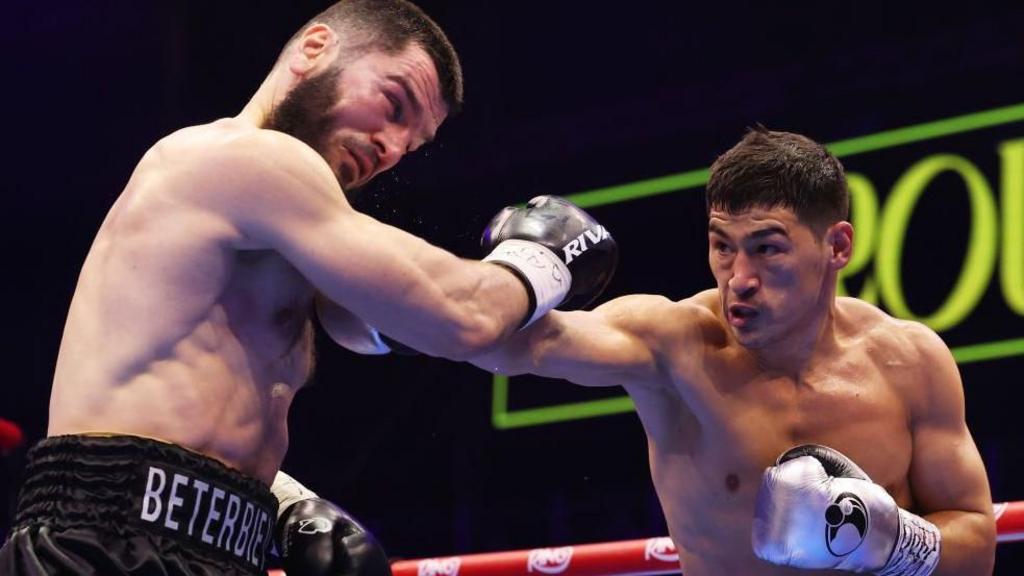
It was never a question of talent. Nor of dedication. Light heavyweight champion Dmitrii Bivol, who in his icy seriousness has dispensed with even a sobriquet, has obvious talent and manifest dedication. What was missing from the Kyrgysan fighter was fire, an emotive component to humanize the surgical application of his skills. Too often in his ascension, Bivol fought like an automaton, a machine:
Prime Directive:
- Establish tactical advantage.
- Secure points lead.
- Exert minimum requisite effort to preserve 1 and 2.
A tactic palatable if employed by a fighter navigating an injury, sure, or an aging fighter marshaling his diminished reserves, by a fragile one ever wary of the catastrophe promised in every false move. In each case, there is some weakness to consider, something to augment the performance and reap inspiration from the seemingly uninspired.
Bivol was none of these. He was because of his talent and a 2010s fetish for fighters from beyond the Caucasus Mountains, expected to be more than unbeatable–more than dominant. Alas, Bivol was dangerously uninteresting: laconic (a quality charming to some but wholly useless in the age of content creators and professional attention-seekers) and both stylistically and temperamentally benumbing between the ropes. If there was passion in Bivol, a capacity to turn a professional boxing match into a fight, it had to be drawn from him. For that violent extraction, Bivol needed the right opponent. To his credit, he sought that man out.
***
While that gaudy record, 21-1 (20 knockouts), might imply otherwise, Artur Beterbiev is not Bivol’s antithesis. He fights, not with passion, but with a steel determination, an unshakeable confidence that his fists, in cumulate or instant, shatter body and mind alike. His pressure is as withering as it is determined because Beterbiev, while he can cut a man down with one punch, is a merchant of attrition, an expert in the inevitable. So while he does not ravage opponents with the verve of a possessed concussionista, Beterbiev promises the kind of spectacle that makes observations about his motivation, his wiring, gratuitous–the obvious in its wide eyes and gasps.
Like Bivol, the Russian-born Beterbiev bore the bloody expectations of the sport, except he satisfied them at every opportunity, ensuring that a division once ruled by an atomizing Adonis and krushing Kovalev remained a perilous place to punch out a living. There was a reason that when Saul Alvarez decided to reinvade the 175-pound division, he chose Bivol as his fall guy, not Betebiev, who was already in his late thirties and had fewer than 20 professional fights. That Bivol chased Alvarez back to super middleweight did nothing to disprove the wisdom of Alvarez’s matchmaking calculation.
But there was no avoiding Beterbiev for Bivol–and no desire to. They first fought in October of last year, with Beterbiev eeking out a majority decision. Perhaps tellingly, those twelve tight rounds featured none of the butchery that typifies a Beterbiev fight. While Beterbiev’s pressure did enough to convince the judges of its efficacy, Bivol was hardly overwhelmed. Bivol offered no excuses that night and acknowledged that he “had to be better” to beat Beterbiev.
***
The quick start made sense. However cagily and calmly Bivol parsed it, Beterbiev knew that his pressure had been the defining element in a fight won by slight advantages and slim margins. So Beterbiev cranked up the pressure early in the rematch, a strategy that might color the judges’ interpretation of the action, might also precipitate the late-round fatigue that Bivol never fully succumbed to, and thereby deliver something definitive, something definingly Beterbievian.
***
Part of what makes Beterbiev’s pressure so impressive is his defense. No fighter with his intentions escapes the outlay of destruction’s design, but Beterbiev does not invite punishment. And early in the fight, he was sharp defensively, catching and slipping Bivol’s punches or closing behind his own to smother the counters. He seemed to hurt Bivol with several right hands in the fifth, and while the rounds were still close, Beterbiev’s auspicious start bore the markings of an all-too-familiar finish.
***
The second half of the fight told a different story. Perhaps it was age, his 40 years conspiring with the demands of a roaring start that tempered Beterbiev. Perhaps. To suggest as much does little to diminish how Bivol seized the opportunity presented by his slowed opponent–for only Bivol could wring blood from that stone. To do it, he had to–as he admitted in October–be better than he’d ever been.
Bivol carried the action from the sixth round on. It was a Herculean effort and, in sharp relief to the almost perfunctory performances that typified Bivol’s early career, an inspired one. Bivol, with his unpredictable rhythm and exhausting lateral movement, stymied Beterbiev’s pressure. To overcome the simplicity of his offense, Bivol turned to volume, unloading with four, five, and even six-punch combinations that overwhelmed Beterbiev, forced him on the defensive, and purpled his face. This was a performance of iron: of iron volition, iron resolve, iron chin–that Bivol won such a fight against the marauding Beterbiev is remarkable. That he barely won the fight only speaks to the severity of the challenge and caliber of fighters involved.
***
As it did in October, the question of who the best light heavyweight in the world is somehow escaped answering. But that answer will come, and definitively, after the inevitable rubber match. Apologies to David Benavidez, a willing and deserving challenger to the light heavyweight king, but that king needs his coronation first. And then at least four months to sharpen his iron.
 In Between Rounds