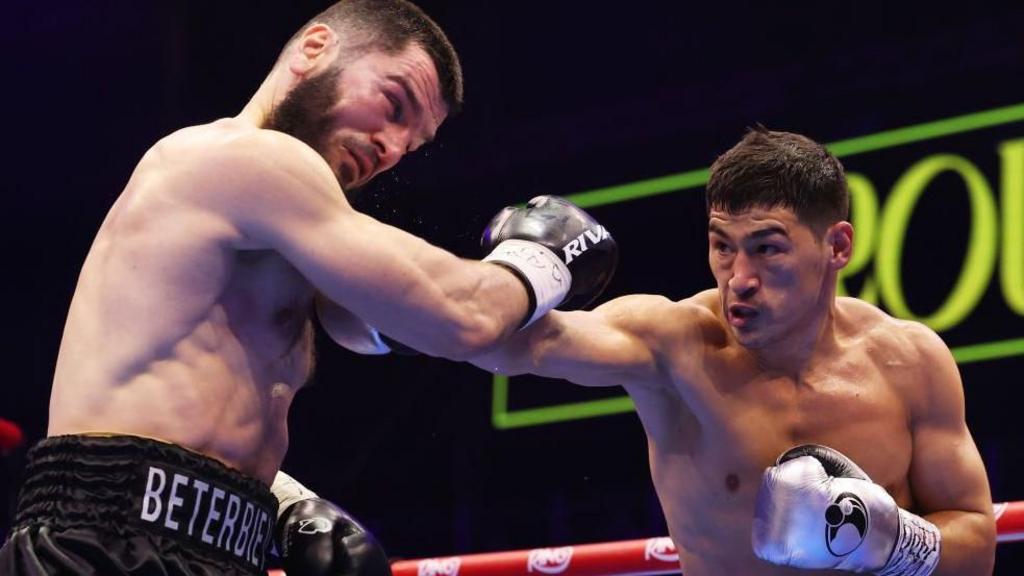
Age of Iron: Dmitrii Bivol Wins Rematch with Artur Beterbiev

It was never a question of talent. Nor of dedication. Light heavyweight champion Dmitrii Bivol, who in his icy seriousness has dispensed with even a sobriquet, has obvious talent and manifest dedication. What was missing from the Kyrgysan fighter was fire, an emotive component to humanize the surgical application of his skills. Too often in his ascension, Bivol fought like an automaton, a machine:

Prime Directive:

  1. Establish tactical advantage.
  2. Secure points lead.
  3. Exert minimum requisite effort to preserve 1 and 2.

A tactic palatable if employed by a fighter navigating an injury, sure, or an aging fighter marshaling his diminished reserves, by a fragile one ever wary of the catastrophe promised in every false move. In each case, there is some weakness to consider, something to augment the performance and reap inspiration from the seemingly uninspired. 

Bivol was none of these. He was because of his talent and a 2010s fetish for fighters from beyond the Caucasus Mountains, expected to be more than unbeatable–more than dominant. Alas, Bivol was dangerously uninteresting: laconic (a quality charming to some but wholly useless in the age of content creators and professional attention-seekers) and both stylistically and temperamentally benumbing between the ropes. If there was passion in Bivol, a capacity to turn a professional boxing match into a fight, it had to be drawn from him. For that violent extraction, Bivol needed the right opponent. To his credit, he sought that man out.

***

While that gaudy record, 21-1 (20 knockouts), might imply otherwise, Artur Beterbiev is not Bivol’s antithesis. He fights, not with passion, but with a steel determination, an unshakeable confidence that his fists, in cumulate or instant, shatter body and mind alike. His pressure is as withering as it is determined because Beterbiev, while he can cut a man down with one punch, is a merchant of attrition, an expert in the inevitable. So while he does not ravage opponents with the verve of a possessed concussionista, Beterbiev promises the kind of spectacle that makes observations about his motivation, his wiring, gratuitous–the obvious in its wide eyes and gasps. 

Like Bivol, the Russian-born Beterbiev bore the bloody expectations of the sport, except he satisfied them at every opportunity, ensuring that a division once ruled by an atomizing Adonis and krushing Kovalev remained a perilous place to punch out a living. There was a reason that when Saul Alvarez decided to reinvade the 175-pound division, he chose Bivol as his fall guy, not Betebiev, who was already in his late thirties and had fewer than 20 professional fights. That Bivol chased Alvarez back to super middleweight did nothing to disprove the wisdom of Alvarez’s matchmaking calculation. 

But there was no avoiding Beterbiev for Bivol–and no desire to. They first fought in October of last year, with Beterbiev eeking out a majority decision. Perhaps tellingly, those twelve tight rounds featured none of the butchery that typifies a Beterbiev fight. While Beterbiev’s pressure did enough to convince the judges of its efficacy, Bivol was hardly overwhelmed. Bivol offered no excuses that night and acknowledged that he “had to be better” to beat Beterbiev.

***

The quick start made sense. However cagily and calmly Bivol parsed it, Beterbiev knew that his pressure had been the defining element in a fight won by slight advantages and slim margins. So Beterbiev cranked up the pressure early in the rematch, a strategy that might color the judges’ interpretation of the action, might also precipitate the late-round fatigue that Bivol never fully succumbed to, and thereby deliver something definitive, something definingly Beterbievian. 

***

Part of what makes Beterbiev’s pressure so impressive is his defense. No fighter with his intentions escapes the outlay of destruction’s design, but Beterbiev does not invite punishment. And early in the fight, he was sharp defensively, catching and slipping Bivol’s punches or closing behind his own to smother the counters. He seemed to hurt Bivol with several right hands in the fifth, and while the rounds were still close, Beterbiev’s auspicious start bore the markings of an all-too-familiar finish. 

***

The second half of the fight told a different story. Perhaps it was age, his 40 years conspiring with the demands of a roaring start that tempered Beterbiev. Perhaps. To suggest as much does little to diminish how Bivol seized the opportunity presented by his slowed opponent–for only Bivol could wring blood from that stone. To do it, he had to–as he admitted in October–be better than he’d ever been. 

Bivol carried the action from the sixth round on. It was a Herculean effort and, in sharp relief to the almost perfunctory performances that typified Bivol’s early career, an inspired one. Bivol, with his unpredictable rhythm and exhausting lateral movement, stymied Beterbiev’s pressure. To overcome the simplicity of his offense, Bivol turned to volume, unloading with four, five, and even six-punch combinations that overwhelmed Beterbiev, forced him on the defensive, and purpled his face. This was a performance of iron: of iron volition, iron resolve, iron chin–that Bivol won such a fight against the marauding Beterbiev is remarkable. That he barely won the fight only speaks to the severity of the challenge and caliber of fighters involved. 

***

As it did in October, the question of who the best light heavyweight in the world is somehow escaped answering. But that answer will come, and definitively, after the inevitable rubber match. Apologies to David Benavidez, a willing and deserving challenger to the light heavyweight king, but that king needs his coronation first. And then at least four months to sharpen his iron.

Slow Boil: David Benavidez Zeroes In On Light Heavyweight Supremacy

It might have been an eliminator of another sort years ago. When Saul Alvarez’s reputation for daring insulated his secretly waning ambition, the two Davids, Benavidez and Morrell, could have turned the screws on him. A fight between Benavidez and Morrell at super middleweight would have left Alvarez with one proven and legitimate threat remaining in the division he had otherwise exhausted. Instead, Alvarez had none, or so he could suggest: each David serving as proof the other was still underserving. 

These politics of avoidance are laughable, of course; sophistic rubbish that acquires its force not from the fighter who offers it but from his supporters, those who wish to defuse criticism of their idol and thus imbue his feeble excuse with a veracity its author could never credit. There was, however, genuine interest in a fight between Benavidez and Morrell, who, without each other, were reduced to reusing Alvarez’s victims or worse. 

To their credit, neither Benavidez nor Morell bothered stalling careers in a division that is, historically, a pitstop. Thus, their fight at the T-Mobile Arena in Las Vegas on Saturday was another eliminator (of sorts). At stake: a chance to face either Artur Beterbiev or Dmitrii Bivol for the light heavyweight crown. In boxing, eliminators and other such promises are ostensibly hollow unless the fighters are determined to validate them. Thankfully, there is little reason to believe the politics of avoidance figure where Beterbiev and Bivol are concerned. 

And certainly not with Benavidez, who clearly, though not without a ratifying moment or two of vulnerability, overwhelmed Morrell in winning a unanimous decision.  

*** 

Watching Benavidez brings to mind the apologue of the boiled frog, which states that a frog will immediately leap out when placed in a pot of boiling water. But if placed in a pot of tepid water gradually brought to a boil, the unfortunate amphibian, unaware of this sinister change, will boil to death. Many a Benavidez opponent has suffered this slow boil. Add Morrell to the list.

***

Against Benavidez, though, Morrell was in his element early, comfortable with the pace, with the deceptive speed and activity of the best opponent in his 12-fight career. The southpaw dropped his hands daringly and flashed an insolent grin as he parsed and mostly neutralized Benavidez, who was already encouraging a fight but had yet to turn up the heat. Morell’s defense was sharp too, though a tad theatrical, excessive not from necessity but from a sense of performance, a need to show everyone—not just the man steadily hunting him—that Morrell was neither underprepared nor overmatched. The price of that gratuitous movement would not go unpaid. 

Morrell seemed to understand that, until proven otherwise, you have to fight Benavidez to beat him. So he stood his ground, throwing with Benavidez, opening up with four and five-punch combinations when Benavidez went to the ropes. In the fourth round, though some of the hubris had drained from his bearing—his stance slightly widened, form slackened just enough to confirm that Benavidez had laid the groundwork for something evil—Morrell struck. A right hook momentarily buckled Benavidez; that crisp shot was sudden and undeniable proof the Cuban fighter could hurt him. But Benavidez responded according to his nature—he unloaded. And for the remainder of the round, all but erased with his assault, that flash of vulnerability. 

***

Benavidez has the unique ability to make his fights personal. There is something in his bearing, the arrogance, the delight in abuse, that, for men no less wired for violence, demands punishment. And something in his style too, in his indefatigability, the torrent of punches in service of one, two, three, four that deliver a debilitating venom. It is a style that would be aggravating were it not so hurtful. And it is applied artfully, with remarkable poise, in an almost self-sustaining manner, with each success seemingly recuperative, restorative, as if whatever the round, whatever his output, the more Benaviidez hits you, the greater his fire. How can you not take such torment personally?

And yet, this is what Benavidez wants: to turn a test of skill, talent, volition, existential, to make it desperate. It is then that he has you—when the water has reached a boil and it is too late to escape. 

There was no escape for Morrell. Yet, to his credit, he continued to fight Benavidez, to stand his ground because victory demanded it and because he’d overpaid for his defense early in the fight. His stylistic rigidity, those simple sequential combinations, however, were no answer for the fluid offensive creativity of Benavidez, who is reactive in the best way, ever ready to capitalize on a wide elbow, a hand brought back too low, a chin caught wagging from fatigue, and to precipitate those errors. Morrell scored a bogus knockdown in the eleventh, sending an off-balance Benavidez to the canvas with a sweep of the shoulder, but negated that ultimately inconsequential advantage when he was deducted a point for hitting after the bell; this nullification symbolic of an insurmountable deficit, of the abyss in class that separates the two. The scores read 118-108 and 115-111(twice) for Benavidez, who seemed appreciative but unmoved by Morrell’s determined effort. 

***

On February 22, the light heavyweight champion will either be newly crowned or confirmed. He already has his next opponent. A fighter who, frustrated with putting his career on hold for a reluctant champion, chose a more difficult path, who, instead of cleaning out a middling division, targeted a more dangerous one. Whoever emerges as the light heavyweight king will be more than happy to make a fight with Benavidez, and make it personal. Benavidez would have it no other way. Nor would we. 

The North Star: On Oleksandr Usyk

How good is heavyweight king Oleksandr Usyk? An absurd question, of course. Usyk has never been good; the word describes neither his talent nor his ambition. And while there was a time as brief as it was promising when Usyk was not yet great—that word, diluted by overuse, is properly earned only with enduring and repeated achievement—he is great now, isn’t he? A marvel of skill, yes, but also navigation. For when has Usyk steered away from danger? Better: when has he, even having earned it, taken a preservative detour? He needs neither the backing of a promoter nor the security of home-canvas judging to succeed: he beats you in front of your promoter, in front of your countrymen, in front of the world. If there is a romanticized element or two in this description of one of the few fighters today who lets his fists do all of his talking, it is also true that if boxing has lost its way in 2024, it need only look to the north star over Ukraine to find its way back. 

Absurd or not, there are ways to answer the opening question. You might look to Usyk’s record, though feel free to ignore his Olympic pedigree. That exclusion is complimentary and warrants a tidy explanation. Very well. Usyk’s Olympic achievements are familiar to anyone who might find the time on a Saturday afternoon to watch him fight, and certainly to anyone bothering to read about him. But his professional feats make his amateur accomplishments gratuitous. There is no need to resort to his gold medals—what he has done since removing his headgear is all that is needed to legitimize him. A fighter dependent on his amateur pedigree to distinguish himself has much work remaining. For what he accomplished in the past six years alone, Usyk could retire tomorrow as one of the defining fighters of his generation. His Olympic feats are the harbinger, not the foundation, of a hall-of-fame career.

Back to his record: it is audaciously unblemished, a timeline of unrivaled achievement reminiscent of Friedrich Nietzsche’s ambition of saying “in ten sentences what others say in a whole book.” Twelve of Usyk’s twenty-three professional fights have been for major titles, including five of his seven fights at heavyweight. He also has two rematches at heavyweight: against Anthony Joshua and Tyson Fury. And while money best explains why Usyk was asked to prove over twenty-four rounds what he made plenty obvious in twelve, those sequels only confirm their predecessors. And add to Usyk’s greatness. Because whatever lesson you may take from facing Usyk once, whatever weakness you might discern in the inevitable but insufficient success you have, whatever confidence you may find in familiarity, know that when you have pushed him as far as you can, he will demand more—more of you, more of himself. And only you will be found wanting. 

As Fury was on Saturday. He was better this time, the “Gypsy King,” who loped into the ring sporting the same indolent flab he used to bolster his chin against Deontay Wilder the night he moved Wilder brutally onto the precipitous downward slope of his career. Perhaps Fury’s rationale Saturday was the same: bulk as counterargument, as nullifer; the limitless nature of the heavyweight division weaponized against a fighter especially beholden to fitness. In getting nearly decapitated by Usyk in May, perhaps Fury realized that whatever resources he invested in trimming down were better allocated elsewhere. But while Fury avoided the late-round collapse that saw him slugged staggering seven months prior, when the outcome hung in the balance Usyk again asked Fury his unanswerable questions and proved once more what separates great fighters from good ones. 

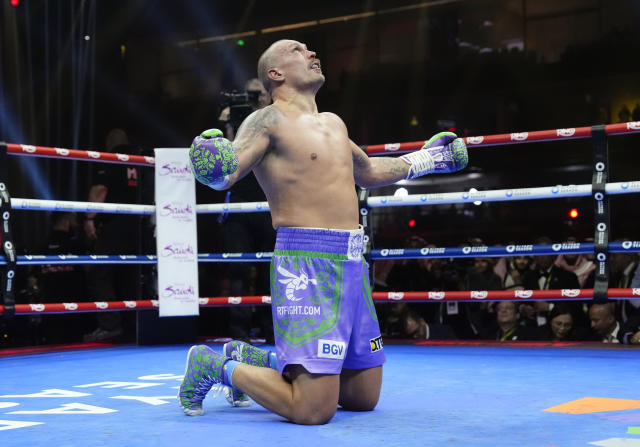
A 6’9” 281-pound man in retreat is an unbecoming spectacle. Defend it with strategy if you like, work yourself into knots as the predictably shameful partisan and plaintive commentary team did—those familiar voices who lionize their countrymen in preparation for defeat. But too often Usyk had the British behemoth on his heels, switching southpaw, flicking jabs with half the determination of his too-frequent clinches. When victory demanded something potentially disastrous, Usyk took a deep breath and bore in, forcing a larger man to decide whether he wanted to win or simply, not utterly, lose. It is this quality above all others that defines Usyk: when that winning moment comes, that moment so many of his fights have, both because he cannot turn a fight with one punch and because he fights, almost exclusively, the kind of men who can—he finds a way to discourage his opponents from seizing it. That is remarkable. It is one thing to hammer a man into unconsciousness, or to cow him with the threat of such a departure; or to diffuse him, to nullify or discourage him by disengaging or by rendering his desperate measures impotent. Usyk does something greater. He meets you at the threshold of your nerve, your fitness, your will—and steps past it. He gives you the chance to take victory by force, you need only be willing to meet his capacity for sacrifice. He is still waiting. 

Minutes after the scorecards were read, minutes after the typically prolix Fury eschewed, in indignance assumingly, a post-fight interview, Daniel Dubois was in the ring, yardbarking his way into a rematch of his 2023 knockout loss to Usyk. How good is Oleksandr Usyk? We are a few months from being sold a rematch with one of his knockout victims.