
This isn’t really about Sergio Martinez. Martinez is one of the characters in the sport who elicits a spectrum of opinion ranging from venomous criticism to idolatrous adoration. These opinions become even more impassioned when the Prince of Culiacan is mentioned. Martinez, as recently as this past Saturday, is vanquishing the opposition without any recourse to opinion. A champion defending his title in his own idiom; his ledger and the manner in which he has compiled it, as consistent as the opinions of him are multifarious. This isn’t really about Sergio Martinez.
No, this is about the new angle spun in the promotion of the King of the Middleweight Division. This is about the Emperor’s new clothes. This new slant argues that Martinez is an undersized middleweight. Martinez, who began his career as a welterweight, didn’t invade the middleweight ranks until 2009, at the advanced age of 35. The process of aging impedes weight loss, and yet Martinez has reportedly found himself comfortably beneath the middleweight limit the week before the fight. Accepting this reasoning—which is different than establishing its truth, mind you—it can be ventured that Martinez is a small middleweight.
Some of the opposition he’s downed as he’s ascended his perch has been small by middleweight standards as well. In his last six fights—roughly the duration of Martinez’ tenure at 160lbs—he has fought Paul Williams twice, Kelly Pavlik, Serhiy Dzindzurik, Darren Barker, and recent knockout victim Matthew Macklin. Williams, himself an ex-resident of the welterweight and junior-welterweight divisions, often proclaimed that he would face anyone from 147-160. Making such a proclamation presupposes that he could indeed make the welterweight limit while retaining his puissance. It’s a dubious claim, but Williams managed to make welterweight in 2008 while fighting primarily between 154 and 160. Williams is a tall but spindly middleweight, and the physical advantages he enjoyed over Martinez would be relevant regardless of weight division. This doesn’t mean Williams was bigger than Martinez, however. Dzindzurik was an undefeated champion at 154lbs, and believed by some to be the best fighter in the division. But he was still campaigning below middleweight. The remaining three fighters were legitimate middleweights when Martinez fought them, and whatever denigrating asterisk might be inserted is either inconsequential or applicable to so many pugs it’s practically irrelevant. So if Martinez is an undersized middleweight, it’s fair to say he’s paired off against a few as well. Why then, draw attention to his size?
The end game for this marketing strategy is probably that it speaks to people who can be swayed by the charms of the pound-for-pound debate. This particular brand of collective onanism is a viable marketing tool given modernity’s preoccupation with lists and a pervading need to establish theoretical superiority. Consider the debate raging between Android, iPhone and Blackberry, or the passionate constituencies lobbying on behalf of The Sopranos, Breaking Bad, and The Wire. There’s a pervading zeitgeist that needs to establish, on subjective grounds, what is the best. Boxing, as another form of publicly appraised drama, has found its cast tabled for similar debate.
When the criteria for determining truth are malleable, and the consequences for being wrong are nil, the debate is self-perpetuating. In essence, what is produced is the opportunity to witness perhaps the best fighter in the world, or the third best, or one of the five best, depending on the criteria. Regardless of the criteria, there’s room for debate therein. Hitching Martinez to this pettifogging cacophony is a sound strategy: it keeps him on people’s lips in a meaningful way. But capitalizing on human inclination isn’t the sole explanation for trumpeting this line of reasoning.
Martinez has of late received criticism for his kvetching over the reticence of Mayweather and Pacquiao. There’s been a shift in ethos, and some who once admonished the sport’s two biggest earners for not stepping way up to the plate have now started complaining about Martinez’ caterwauling. By drawing the collective attention to Martinez’ size, the hope is to reduce the criticism he’s received for tirelessly seeking out fights with men who generally ply their trade two divisions south of him. If Martinez is a small middleweight—perhaps a largish junior-middleweight—then pursuing a Mayweather fight isn’t bullying. Mayweather, after all, has explicitly stated that his May tussle with Miguel Cotto is to be waged at 154lbs to ensure that the best of the Puerto Rican fighter is on display. Of course, anything Mayweather says should be downed with a chaser, but the fact remains that the fight will be fought at the junior-middleweight limit. This means that the undersized middleweight Martinez should, physically speaking, be in the running for a Mayweather fight. The size differential is negated to a large degree.
The same rationale can be applied to Pacquiao, though with less persuading results. That being said, the Mayweather fight has seemingly been the one Martinez most coveted, probably because Mayweather is the larger of the two stars and thus more likely to navigate the waters of junior-middleweight again.
The move insulates Martinez in another significant way: it protects him from the rabble demanding that he—since he’s so comfortable challenging smaller men to fight him—take the deontologist’s path north. There are a number of names at super-middleweight—Froch, Kessler, Bute—that could ensure packed houses for Martinez were he to try his low-hanging hands at 168lbs. Team Martinez has responded to suggestions of this nature before, stating that were the right deal to come along Martinez would consider the move. The right deal being as nebulous and elusive a concept as it is, it’s hard to pressure the fighter for not accepting solicitations to come upstairs. Of course, that doesn’t mean he doesn’t get criticized for a perceived hypocrisy. But if the public is told forcefully or consistently enough that Martinez is a small middleweight then the move to super-middleweight becomes more unrealistic, more demanding, more dangerous, especially since the move to junior-middleweight is more in keeping with his natural build.
It must be said that this new marketing tactic for Martinez is brilliant. It’s arguably rooted in truth, bears a fruit most find delicious, and provides a thorny defence. Moreover, Martinez himself is a fine fighter, and regardless of the spin, his performances—even if their dominance is receding—are always there to salvage his merits. Were this really about Sergio Martinez it could be said that his rather fruitless promotional campaign may have finally yielded a crop. But then, this isn’t really about Sergio Martinez.

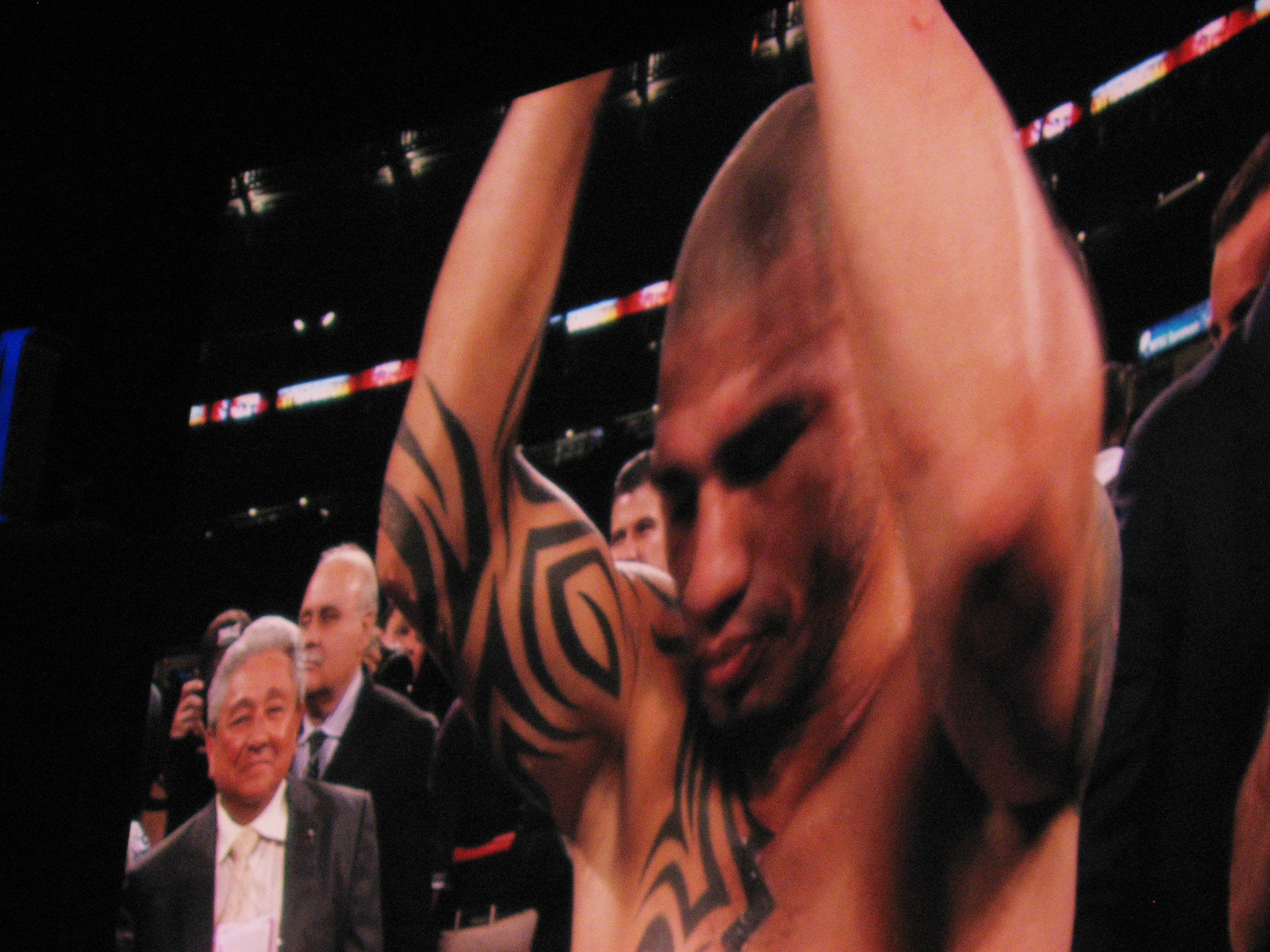


 In Between Rounds