The Audit: Lamont Roach Jr., Gervonta Davis, Steve Willis, and the Win That Wasn’t

“Abso-fucking-lutely.” What answer would you expect from the self-professed face of boxing when asked if he had achieved such popularity? It was the answer lightweight slugger Gervonta “Tank” Davis gave in April 2023, minutes after removing Ryan “Kingry” Garcia’s liver. This tidy surgery momentarily ablated an imposter and won Davis the support of aficionados who demand ring credibility be earned anywhere but on Instagram Live.

If Davis was wrong in esteeming himself so highly, proving as much required some nuance: reference to domestic and global markets, gate revenues, pay-per-view buys, and other metrics leveraged in debates about what cannot be settled between the ropes. But there is no questioning Davis’s popularity: he set a gate record for Barclay’s Center in Brooklyn on Saturday, and if that is not evidence enough to satisfy you, he somehow left the ring with his title, too. 

As much as a -1800 favorite, Davis was expected to shatter the overmatched Lamont Roach Jr., who represented—at least to skeptics unwilling to bestow on Davis a greatness commensurate with his popularity—further matchmaking sagacity. Where Davis is concerned, describing matchmaking as sagacious, even shrewd, has increasingly felt too charitable. 

He does not fight his fellow champions unless, as with Roach, he can coax them up a division. Yet, Davis is no more interested in pursuing challenges beyond the lightweight division than he is in unifying it. The title that Davis and his braintrust prioritize above all is the one he gave himself after beating Garcia. His matchmaking is not aspirational, not ambitious, not daring, but preservative, uninspiring in so far as it seems to rest on the assumption that what Davis supporters want above all is to see their image of him confirmed—no matter how poor the matchmaking required to ensure as much. 

In this regard, Davis is not unlike the faces of boxing that preceded him: Floyd Mayweather Jr. and Saul Alvarez, who were events unto themselves, the kind of attractions that could, at least once a year, successfully subject even the most discerning public to a foregone conclusion. A merchant of sudden and stunning violence, charming in his blend of boorishness and humor, there is little wonder Davis is so popular. However, he has but a fraction of the popularity of Mayweather Jr. and Alvarez and barely any of their credentials. 

If this last estimation of Davis is reactionary, hypercritical, what might explain it?

***

Courage is found not in matchmaking but in comportment, not in the promise of danger but in welcoming it. Lamont Roach is a courageous fighter. Not because he accepted a fight with Davis, not because he moved up a division to make it, but because when alone in the ring with Davis, with that serpentine speed and venom, Roach never blinked. Davis will come under the scalpel in the coming days: his uncharacteristic passivity, his ineffectual pressure and power subject to a pulverizing critique. So must referee Steve Willis, whose criminal incompetence denied Roach a career-defining win and the financial windfall accompanying it. But Roach, who in his grit and craft forced a reevaluation of Davis, must not be lost in that bandwidth and banter—that would be yet one more injustice visited upon him. No, Roach should be celebrated. 

***

Because “The Reaper” was phenomenal Saturday—directly responsible for the oddness of Davis’s showing and, ultimately, the shame of Willis’s. Unintimidated and unimpressed by both the reputation and the man, Roach planted himself directly in front of Davis, and out of that perilous position, ripped off blistering counter right hand after blistering counter right hand. When Davis looked to duck into Roach, to hide in the blindspots he exploits so fruitfully against larger opponents, Roach slugged him with body shots. Expecting to goad Roach into the kind of firefight that ends but one way for those caught in the sights of “Tank,” Davis was surprised to find himself getting outfought in the exchanges. Roach could neither be unnerved nor instigated: his discipline, the composure to throw four and five-punch combinations without ever getting greedy, to always angle out after an attack—is it any wonder Davis began jawing at him at about the time in the fight when the Baltimore fighter typically takes control?  

That discipline spoke to Roach’s training, yes, to his bearing, but also his contempt. It is not uncommon for Davis’s opponents to become frantic or reckless, to throw desperately rather than purposefully, to betray concerns about their safety with their panicked aggression. Roach experienced no such crisis of confidence. He conceded nothing. Instead, Roach fought like Davis was beneath him, an overrated and unfit challenger for some deeply existential distinction worth tempting annihilation for. That fiery defiance affected an opponent expecting only to manifest another outcome predetermined by matchmaking. 

***

Despite his success, despite fighting near-perfectly against an opponent who exploits mistakes with brutal finality, Roach was just good enough against Davis (who has suspect ambition but undeniable talent, and even flummoxed kept the rounds close). And this tense contest only augmented Roach’s incredible performance and the coming injustice.

Roach needed a knockdown, a point deduction—an arithmetical cushion to insulate him against his limitations and the influence of the house fighter. He almost got it. 

***

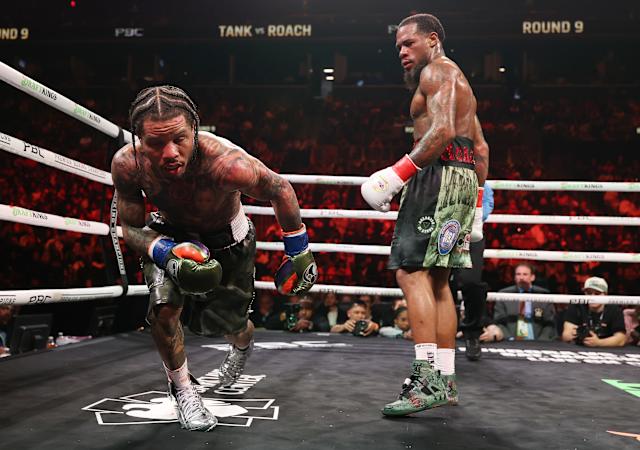
In the ninth round, Davis took a knee after eating a jab from Roach, then quickly ran to his corner to have his face wiped. Willis sent Roach to a neutral corner and seemed to begin his count, only to stop and ask Davis for an explanation, warning him that “you take a knee like that, that looks like a knockdown,” before waving Roach in. 

That act of referee what? Favoritism? Incompetence? Charity? Discretion? Fuckery? cost Roach the fight. However inspired his performance, however remarkable, it was just enough to beat Davis, and only if the judging respected him in ways the refereeing did not. Alas, judge Eric Marlinksi scored the fight 115-113 for Davis, while judges Steve Weisfeld and Glenn Feldman scored it 114-114, resulting in a majority draw. Without the advantage of the obvious knockdown—a knockdown Davis admitted to on social media, posting that he “did that bullshit knee”— without Davis getting disqualified for having his cornerman on the canvas, wiping his face during the round, Roach came up short. 

***

What follows? Surely an immediate rematch, a welcome opportunity to settle matters in a sanguine and satisfactory manner? Perhaps not. 

Despite stating his wish to rematch Roach immediately, Davis said plans for his next opponent were already in place. Such premature negotiations are hardly unusual, especially for a fighter who has given little indication he cares at all for measuring his worth in anything but dollars. 

Davis may be the face of boxing, but does that face have egg on it? Abso-fucking-lutely. 
Age of Iron: Dmitrii Bivol Wins Rematch with Artur Beterbiev

It was never a question of talent. Nor of dedication. Light heavyweight champion Dmitrii Bivol, who in his icy seriousness has dispensed with even a sobriquet, has obvious talent and manifest dedication. What was missing from the Kyrgysan fighter was fire, an emotive component to humanize the surgical application of his skills. Too often in his ascension, Bivol fought like an automaton, a machine:

Prime Directive:

  1. Establish tactical advantage.
  2. Secure points lead.
  3. Exert minimum requisite effort to preserve 1 and 2.

A tactic palatable if employed by a fighter navigating an injury, sure, or an aging fighter marshaling his diminished reserves, by a fragile one ever wary of the catastrophe promised in every false move. In each case, there is some weakness to consider, something to augment the performance and reap inspiration from the seemingly uninspired. 

Bivol was none of these. He was because of his talent and a 2010s fetish for fighters from beyond the Caucasus Mountains, expected to be more than unbeatable–more than dominant. Alas, Bivol was dangerously uninteresting: laconic (a quality charming to some but wholly useless in the age of content creators and professional attention-seekers) and both stylistically and temperamentally benumbing between the ropes. If there was passion in Bivol, a capacity to turn a professional boxing match into a fight, it had to be drawn from him. For that violent extraction, Bivol needed the right opponent. To his credit, he sought that man out.

***

While that gaudy record, 21-1 (20 knockouts), might imply otherwise, Artur Beterbiev is not Bivol’s antithesis. He fights, not with passion, but with a steel determination, an unshakeable confidence that his fists, in cumulate or instant, shatter body and mind alike. His pressure is as withering as it is determined because Beterbiev, while he can cut a man down with one punch, is a merchant of attrition, an expert in the inevitable. So while he does not ravage opponents with the verve of a possessed concussionista, Beterbiev promises the kind of spectacle that makes observations about his motivation, his wiring, gratuitous–the obvious in its wide eyes and gasps. 

Like Bivol, the Russian-born Beterbiev bore the bloody expectations of the sport, except he satisfied them at every opportunity, ensuring that a division once ruled by an atomizing Adonis and krushing Kovalev remained a perilous place to punch out a living. There was a reason that when Saul Alvarez decided to reinvade the 175-pound division, he chose Bivol as his fall guy, not Betebiev, who was already in his late thirties and had fewer than 20 professional fights. That Bivol chased Alvarez back to super middleweight did nothing to disprove the wisdom of Alvarez’s matchmaking calculation. 

But there was no avoiding Beterbiev for Bivol–and no desire to. They first fought in October of last year, with Beterbiev eeking out a majority decision. Perhaps tellingly, those twelve tight rounds featured none of the butchery that typifies a Beterbiev fight. While Beterbiev’s pressure did enough to convince the judges of its efficacy, Bivol was hardly overwhelmed. Bivol offered no excuses that night and acknowledged that he “had to be better” to beat Beterbiev.

***

The quick start made sense. However cagily and calmly Bivol parsed it, Beterbiev knew that his pressure had been the defining element in a fight won by slight advantages and slim margins. So Beterbiev cranked up the pressure early in the rematch, a strategy that might color the judges’ interpretation of the action, might also precipitate the late-round fatigue that Bivol never fully succumbed to, and thereby deliver something definitive, something definingly Beterbievian. 

***

Part of what makes Beterbiev’s pressure so impressive is his defense. No fighter with his intentions escapes the outlay of destruction’s design, but Beterbiev does not invite punishment. And early in the fight, he was sharp defensively, catching and slipping Bivol’s punches or closing behind his own to smother the counters. He seemed to hurt Bivol with several right hands in the fifth, and while the rounds were still close, Beterbiev’s auspicious start bore the markings of an all-too-familiar finish. 

***

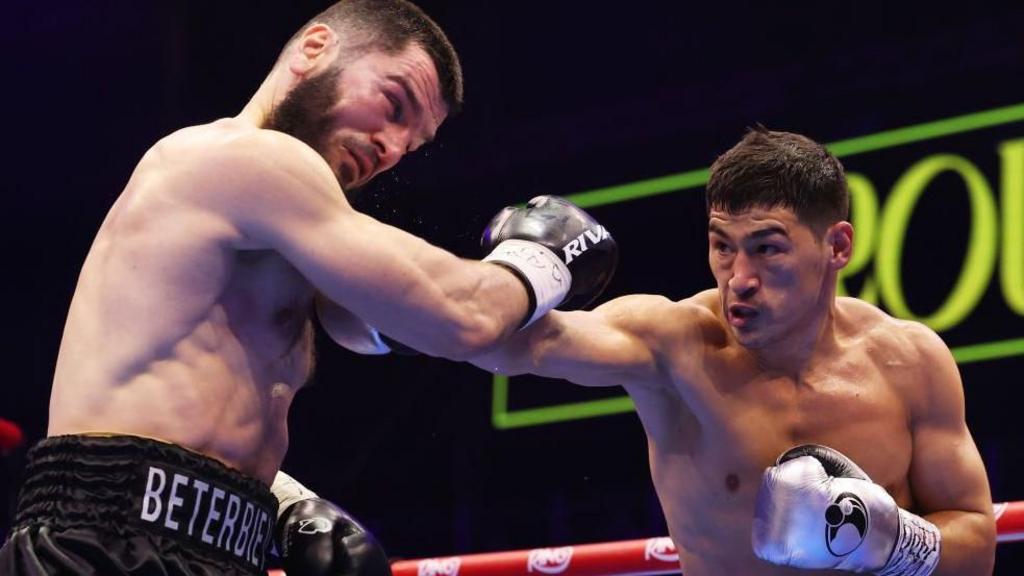
The second half of the fight told a different story. Perhaps it was age, his 40 years conspiring with the demands of a roaring start that tempered Beterbiev. Perhaps. To suggest as much does little to diminish how Bivol seized the opportunity presented by his slowed opponent–for only Bivol could wring blood from that stone. To do it, he had to–as he admitted in October–be better than he’d ever been. 

Bivol carried the action from the sixth round on. It was a Herculean effort and, in sharp relief to the almost perfunctory performances that typified Bivol’s early career, an inspired one. Bivol, with his unpredictable rhythm and exhausting lateral movement, stymied Beterbiev’s pressure. To overcome the simplicity of his offense, Bivol turned to volume, unloading with four, five, and even six-punch combinations that overwhelmed Beterbiev, forced him on the defensive, and purpled his face. This was a performance of iron: of iron volition, iron resolve, iron chin–that Bivol won such a fight against the marauding Beterbiev is remarkable. That he barely won the fight only speaks to the severity of the challenge and caliber of fighters involved. 

***

As it did in October, the question of who the best light heavyweight in the world is somehow escaped answering. But that answer will come, and definitively, after the inevitable rubber match. Apologies to David Benavidez, a willing and deserving challenger to the light heavyweight king, but that king needs his coronation first. And then at least four months to sharpen his iron.

Slow Boil: David Benavidez Zeroes In On Light Heavyweight Supremacy

It might have been an eliminator of another sort years ago. When Saul Alvarez’s reputation for daring insulated his secretly waning ambition, the two Davids, Benavidez and Morrell, could have turned the screws on him. A fight between Benavidez and Morrell at super middleweight would have left Alvarez with one proven and legitimate threat remaining in the division he had otherwise exhausted. Instead, Alvarez had none, or so he could suggest: each David serving as proof the other was still underserving. 

These politics of avoidance are laughable, of course; sophistic rubbish that acquires its force not from the fighter who offers it but from his supporters, those who wish to defuse criticism of their idol and thus imbue his feeble excuse with a veracity its author could never credit. There was, however, genuine interest in a fight between Benavidez and Morrell, who, without each other, were reduced to reusing Alvarez’s victims or worse. 

To their credit, neither Benavidez nor Morell bothered stalling careers in a division that is, historically, a pitstop. Thus, their fight at the T-Mobile Arena in Las Vegas on Saturday was another eliminator (of sorts). At stake: a chance to face either Artur Beterbiev or Dmitrii Bivol for the light heavyweight crown. In boxing, eliminators and other such promises are ostensibly hollow unless the fighters are determined to validate them. Thankfully, there is little reason to believe the politics of avoidance figure where Beterbiev and Bivol are concerned. 

And certainly not with Benavidez, who clearly, though not without a ratifying moment or two of vulnerability, overwhelmed Morrell in winning a unanimous decision.  

*** 

Watching Benavidez brings to mind the apologue of the boiled frog, which states that a frog will immediately leap out when placed in a pot of boiling water. But if placed in a pot of tepid water gradually brought to a boil, the unfortunate amphibian, unaware of this sinister change, will boil to death. Many a Benavidez opponent has suffered this slow boil. Add Morrell to the list.

***

Against Benavidez, though, Morrell was in his element early, comfortable with the pace, with the deceptive speed and activity of the best opponent in his 12-fight career. The southpaw dropped his hands daringly and flashed an insolent grin as he parsed and mostly neutralized Benavidez, who was already encouraging a fight but had yet to turn up the heat. Morell’s defense was sharp too, though a tad theatrical, excessive not from necessity but from a sense of performance, a need to show everyone—not just the man steadily hunting him—that Morrell was neither underprepared nor overmatched. The price of that gratuitous movement would not go unpaid. 

Morrell seemed to understand that, until proven otherwise, you have to fight Benavidez to beat him. So he stood his ground, throwing with Benavidez, opening up with four and five-punch combinations when Benavidez went to the ropes. In the fourth round, though some of the hubris had drained from his bearing—his stance slightly widened, form slackened just enough to confirm that Benavidez had laid the groundwork for something evil—Morrell struck. A right hook momentarily buckled Benavidez; that crisp shot was sudden and undeniable proof the Cuban fighter could hurt him. But Benavidez responded according to his nature—he unloaded. And for the remainder of the round, all but erased with his assault, that flash of vulnerability. 

***

Benavidez has the unique ability to make his fights personal. There is something in his bearing, the arrogance, the delight in abuse, that, for men no less wired for violence, demands punishment. And something in his style too, in his indefatigability, the torrent of punches in service of one, two, three, four that deliver a debilitating venom. It is a style that would be aggravating were it not so hurtful. And it is applied artfully, with remarkable poise, in an almost self-sustaining manner, with each success seemingly recuperative, restorative, as if whatever the round, whatever his output, the more Benaviidez hits you, the greater his fire. How can you not take such torment personally?

And yet, this is what Benavidez wants: to turn a test of skill, talent, volition, existential, to make it desperate. It is then that he has you—when the water has reached a boil and it is too late to escape. 

There was no escape for Morrell. Yet, to his credit, he continued to fight Benavidez, to stand his ground because victory demanded it and because he’d overpaid for his defense early in the fight. His stylistic rigidity, those simple sequential combinations, however, were no answer for the fluid offensive creativity of Benavidez, who is reactive in the best way, ever ready to capitalize on a wide elbow, a hand brought back too low, a chin caught wagging from fatigue, and to precipitate those errors. Morrell scored a bogus knockdown in the eleventh, sending an off-balance Benavidez to the canvas with a sweep of the shoulder, but negated that ultimately inconsequential advantage when he was deducted a point for hitting after the bell; this nullification symbolic of an insurmountable deficit, of the abyss in class that separates the two. The scores read 118-108 and 115-111(twice) for Benavidez, who seemed appreciative but unmoved by Morrell’s determined effort. 

***

On February 22, the light heavyweight champion will either be newly crowned or confirmed. He already has his next opponent. A fighter who, frustrated with putting his career on hold for a reluctant champion, chose a more difficult path, who, instead of cleaning out a middling division, targeted a more dangerous one. Whoever emerges as the light heavyweight king will be more than happy to make a fight with Benavidez, and make it personal. Benavidez would have it no other way. Nor would we.