
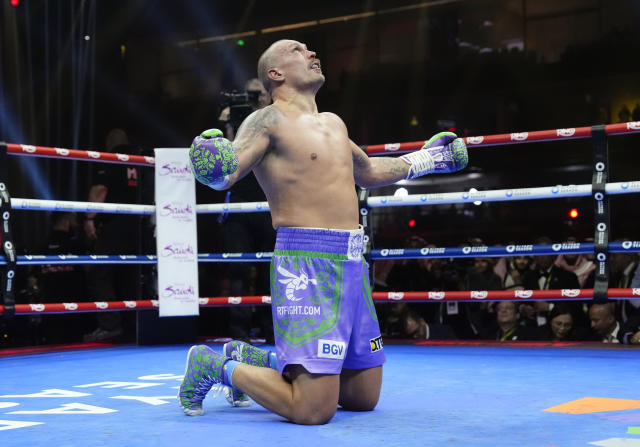
How good is heavyweight king Oleksandr Usyk? An absurd question, of course. Usyk has never been good; the word describes neither his talent nor his ambition. And while there was a time as brief as it was promising when Usyk was not yet great—that word, diluted by overuse, is properly earned only with enduring and repeated achievement—he is great now, isn’t he? A marvel of skill, yes, but also navigation. For when has Usyk steered away from danger? Better: when has he, even having earned it, taken a preservative detour? He needs neither the backing of a promoter nor the security of home-canvas judging to succeed: he beats you in front of your promoter, in front of your countrymen, in front of the world. If there is a romanticized element or two in this description of one of the few fighters today who lets his fists do all of his talking, it is also true that if boxing has lost its way in 2024, it need only look to the north star over Ukraine to find its way back.
Absurd or not, there are ways to answer the opening question. You might look to Usyk’s record, though feel free to ignore his Olympic pedigree. That exclusion is complimentary and warrants a tidy explanation. Very well. Usyk’s Olympic achievements are familiar to anyone who might find the time on a Saturday afternoon to watch him fight, and certainly to anyone bothering to read about him. But his professional feats make his amateur accomplishments gratuitous. There is no need to resort to his gold medals—what he has done since removing his headgear is all that is needed to legitimize him. A fighter dependent on his amateur pedigree to distinguish himself has much work remaining. For what he accomplished in the past six years alone, Usyk could retire tomorrow as one of the defining fighters of his generation. His Olympic feats are the harbinger, not the foundation, of a hall-of-fame career.
Back to his record: it is audaciously unblemished, a timeline of unrivaled achievement reminiscent of Friedrich Nietzsche’s ambition of saying “in ten sentences what others say in a whole book.” Twelve of Usyk’s twenty-three professional fights have been for major titles, including five of his seven fights at heavyweight. He also has two rematches at heavyweight: against Anthony Joshua and Tyson Fury. And while money best explains why Usyk was asked to prove over twenty-four rounds what he made plenty obvious in twelve, those sequels only confirm their predecessors. And add to Usyk’s greatness. Because whatever lesson you may take from facing Usyk once, whatever weakness you might discern in the inevitable but insufficient success you have, whatever confidence you may find in familiarity, know that when you have pushed him as far as you can, he will demand more—more of you, more of himself. And only you will be found wanting.
As Fury was on Saturday. He was better this time, the “Gypsy King,” who loped into the ring sporting the same indolent flab he used to bolster his chin against Deontay Wilder the night he moved Wilder brutally onto the precipitous downward slope of his career. Perhaps Fury’s rationale Saturday was the same: bulk as counterargument, as nullifer; the limitless nature of the heavyweight division weaponized against a fighter especially beholden to fitness. In getting nearly decapitated by Usyk in May, perhaps Fury realized that whatever resources he invested in trimming down were better allocated elsewhere. But while Fury avoided the late-round collapse that saw him slugged staggering seven months prior, when the outcome hung in the balance Usyk again asked Fury his unanswerable questions and proved once more what separates great fighters from good ones.
A 6’9” 281-pound man in retreat is an unbecoming spectacle. Defend it with strategy if you like, work yourself into knots as the predictably shameful partisan and plaintive commentary team did—those familiar voices who lionize their countrymen in preparation for defeat. But too often Usyk had the British behemoth on his heels, switching southpaw, flicking jabs with half the determination of his too-frequent clinches. When victory demanded something potentially disastrous, Usyk took a deep breath and bore in, forcing a larger man to decide whether he wanted to win or simply, not utterly, lose. It is this quality above all others that defines Usyk: when that winning moment comes, that moment so many of his fights have, both because he cannot turn a fight with one punch and because he fights, almost exclusively, the kind of men who can—he finds a way to discourage his opponents from seizing it. That is remarkable. It is one thing to hammer a man into unconsciousness, or to cow him with the threat of such a departure; or to diffuse him, to nullify or discourage him by disengaging or by rendering his desperate measures impotent. Usyk does something greater. He meets you at the threshold of your nerve, your fitness, your will—and steps past it. He gives you the chance to take victory by force, you need only be willing to meet his capacity for sacrifice. He is still waiting.
Minutes after the scorecards were read, minutes after the typically prolix Fury eschewed, in indignance assumingly, a post-fight interview, Daniel Dubois was in the ring, yardbarking his way into a rematch of his 2023 knockout loss to Usyk. How good is Oleksandr Usyk? We are a few months from being sold a rematch with one of his knockout victims.

 In Between Rounds